

Baldor’s Algebra, a cornerstone of mathematics education, particularly in Latin America, has a rich history. Its digitized versions, like those found on the Internet Archive,
offer convenient access to this classic text. The identifier ALGEBRADeBALDOR_20181029 marks a specific edition available for download and streaming.
Historical Context of Baldor’s Algebra
Baldor’s Algebra emerged as a pivotal educational resource in the early to mid-20th century, primarily gaining prominence throughout Latin America. Authored by Aurelio Baldor, a renowned Uruguayan mathematician and educator, the text was initially designed to standardize and strengthen algebra instruction across diverse educational institutions. Its enduring legacy stems from a clear, methodical approach to algebraic concepts, making it accessible to a wide range of students.
The book’s widespread adoption coincided with a period of educational reform in many Latin American countries, seeking to establish robust mathematical foundations for future generations. The Internet Archive’s preservation of editions, identified by codes like urn:lcp:ALGEBRA_de_BALDOR:epub:6a674977-46f8-42e9-8601-5f237e2b8918 and identifier ALGEBRADeBALDOR_20181029, demonstrates its continued relevance.
The digitization efforts, utilizing OCR technology (tesseract 5.3.0-6-g76ae), ensure that Baldor’s work remains available to students and educators even as physical copies become scarce. This historical context underscores the book’s role not merely as a textbook, but as a cultural artifact representing a commitment to mathematical literacy.
Significance of Baldor’s Algebra in Latin American Education
Baldor’s Algebra holds a uniquely significant position within the history of Latin American education. For decades, it served as the standard textbook for secondary school algebra across numerous countries, shaping the mathematical understanding of generations of students. Its influence extends beyond simply presenting algebraic principles; it fostered a common mathematical language and skillset throughout the region.
The book’s enduring popularity is attributable to its rigorous yet accessible approach, emphasizing problem-solving and conceptual understanding. The availability of PDF versions, as cataloged on the Internet Archive (identifier ALGEBRADeBALDOR_20181029, ark:/13960/t3jx5p99f), has further cemented its legacy, providing continued access to this vital resource.
The OCR processing (tesseract 5.3.0-6-g76ae) applied to these digital copies ensures the text remains searchable and usable for modern learners. Baldor’s Algebra isn’t just a textbook; it represents a shared educational experience and a foundational element of mathematical education in Latin America, preserved for future study.
Content Overview of Baldor’s Algebra
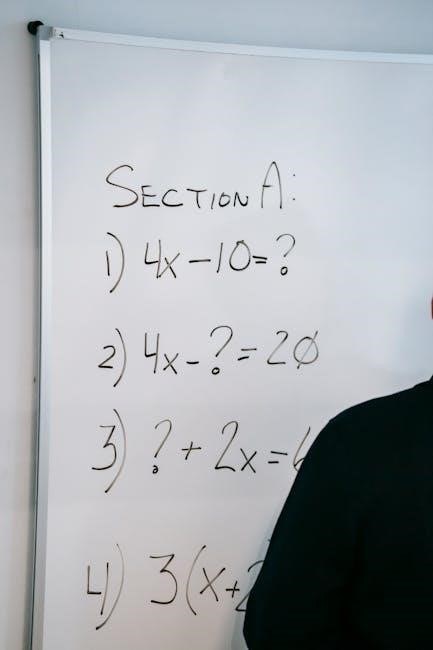
Baldor’s Algebra systematically covers fundamental concepts, equations, polynomials, and radicals. Digitized versions, like the Internet Archive’s (urn:lcp:ALGEBRA_de_BALDOR:epub:6a674977-46f8-42e9-8601-5f237e2b8918), preserve this comprehensive curriculum.
Fundamental Algebraic Concepts Covered
Baldor’s Algebra meticulously lays the groundwork for algebraic understanding, beginning with foundational concepts. These include variables, constants, coefficients, and the essential operations – addition, subtraction, multiplication, and division – applied to algebraic expressions. The text thoroughly explores the properties of real numbers, such as commutativity, associativity, and distributivity, providing numerous examples to solidify comprehension.
A significant portion is dedicated to simplifying expressions through combining like terms and applying the order of operations. The concept of exponents and radicals is introduced early, building a crucial base for later topics. Furthermore, Baldor’s Algebra delves into absolute value, inequalities, and the representation of numbers on the number line.
The Internet Archive’s digitized version (Identifier: ALGEBRADeBALDOR_20181029) faithfully reproduces this structured approach. Students benefit from the systematic progression, ensuring a strong grasp of these core principles before advancing to more complex algebraic manipulations. The OCR processing (tesseract 5.3.0-6-g76ae) ensures readability of these fundamental concepts within the PDF format.
Detailed Examination of Equations and Inequalities
Baldor’s Algebra provides an exhaustive treatment of equations and inequalities, forming a central pillar of its content. It begins with linear equations in one variable, progressing to more complex forms involving multiple variables. The method of solving equations through isolating the variable is meticulously explained, accompanied by a wealth of practice problems.
Inequalities are addressed with equal rigor, covering linear inequalities, absolute value inequalities, and systems of inequalities. Graphical representations of solutions on the number line are emphasized, fostering a visual understanding. The text also explores applications of equations and inequalities to real-world problems, enhancing their relevance.

The PDF versions available, such as the one identified as ALGEBRADeBALDOR_20181029 on the Internet Archive, retain this detailed approach. The OCR process (Ocr_detected_lang: es, Ocr_detected_script: Latin) ensures accurate rendering of the mathematical notation within the digital format. Students can readily access and work through these crucial concepts, benefiting from Baldor’s clear explanations and extensive problem sets.
Polynomials and Their Operations
Baldor’s Algebra dedicates significant attention to polynomials, defining them as algebraic expressions consisting of terms with coefficients and variables raised to non-negative integer powers. The text systematically covers fundamental operations: addition, subtraction, multiplication, and division of polynomials.
Emphasis is placed on understanding polynomial terminology – degree, leading coefficient, and types of polynomials (monomial, binomial, trinomial). Detailed examples illustrate the application of the distributive property and other algebraic rules during polynomial manipulation. Long division of polynomials is explained step-by-step, preparing students for more advanced techniques.

Accessing Baldor’s Algebra in PDF format, like the version archived with identifier ALGEBRADeBALDOR_20181029, preserves the clarity of these explanations. The OCR technology (Ocr_module_version 0.0.21, Ocr_parameters -l spa) ensures accurate display of mathematical symbols. This digital accessibility allows students to practice polynomial operations efficiently, reinforcing their understanding of these core algebraic concepts.
Factoring Techniques Explained
Baldor’s Algebra provides a comprehensive exploration of factoring, a crucial skill for simplifying algebraic expressions and solving equations. The text meticulously details various techniques, beginning with factoring out the greatest common factor (GCF). It then progresses to factoring differences of squares, perfect square trinomials, and general quadratic trinomials.
Students learn to recognize patterns and apply appropriate methods for each type of expression. The book emphasizes the importance of checking factored forms through multiplication. Complex factoring problems are broken down into manageable steps, fostering a strong understanding of the underlying principles.
The availability of Baldor’s Algebra in PDF format (identified as ALGEBRADeBALDOR_20181029 on the Internet Archive) enhances learning. The OCR process (Ocr_detected_lang es, Ocr_detected_script Latin) ensures accurate rendering of mathematical notation. Students can easily revisit examples and practice problems, solidifying their mastery of these essential factoring techniques, benefitting from a readily accessible resource.
Rational Expressions and Equations

Baldor’s Algebra dedicates significant attention to rational expressions and equations, building upon foundational algebraic concepts. The text systematically covers simplifying rational expressions by factoring both numerators and denominators, identifying common factors for cancellation. It then extends to operations – addition, subtraction, multiplication, and division – of these expressions, emphasizing the importance of finding common denominators.
Solving rational equations is presented with a focus on identifying extraneous solutions, a critical step often overlooked. The book provides numerous examples illustrating these techniques, progressively increasing in complexity. Students learn to manipulate equations to isolate variables while respecting the restrictions imposed by the denominators.
Accessing Baldor’s Algebra in PDF format (identified as ALGEBRADeBALDOR_20181029 via the Internet Archive) offers a convenient study aid. The OCR technology (Ocr_module_version 0.0.21, Ocr_parameters -l spa) ensures the accurate display of mathematical symbols, facilitating self-paced learning and problem-solving practice.
Radicals and Rational Exponents
Baldor’s Algebra meticulously explores radicals and rational exponents, establishing a firm understanding of their interrelationship. The text begins with simplifying radical expressions, covering concepts like extracting perfect square roots and rationalizing denominators. It progresses to operations involving radicals – addition, subtraction, multiplication, and division – emphasizing the rules for combining like radicals.
Rational exponents are introduced as an alternative representation of radicals, allowing for the application of exponent rules to radical expressions. This connection is crucial for advanced algebraic manipulations. The book provides ample practice problems, gradually increasing in difficulty, to solidify these concepts.
Utilizing a PDF version of Baldor’s Algebra, such as the one cataloged on the Internet Archive (urn:lcp:ALGEBRA_de_BALDOR:epub:6a674977-46f8-42e9-8601-5f237e2b8918), offers portability and accessibility. The OCR process (Ocr_detected_lang es, Ocr_detected_lang_conf 1.0000) ensures accurate rendering of mathematical notation, aiding comprehension and efficient study.
Quadratic Equations and Functions
Baldor’s Algebra dedicates significant attention to quadratic equations and functions, foundational elements of higher mathematics. The text systematically covers methods for solving quadratic equations, including factoring, completing the square, and the quadratic formula. Emphasis is placed on understanding the discriminant and its implications for the nature of the roots – real, distinct, or complex.
The graphical representation of quadratic functions is explored, detailing the properties of parabolas, such as the vertex, axis of symmetry, and intercepts. Students learn to analyze quadratic functions to determine maximum or minimum values and their applications in real-world scenarios.
Accessing a PDF version of Baldor’s Algebra, readily available through resources like the Internet Archive (Identifier: ALGEBRADeBALDOR_20181029, Ocr_module_version 0.0.21), provides a convenient and cost-effective learning tool. The OCR technology (Ocr_detected_script Latin, Ocr_detected_script_conf 0.8520) ensures the accurate display of mathematical symbols and equations, facilitating self-study and problem-solving.
Logarithmic and Exponential Functions
Baldor’s Algebra provides a comprehensive treatment of logarithmic and exponential functions, building upon the previously established foundations of exponents and radicals. The text meticulously defines logarithms as the inverse of exponential functions, exploring their properties and relationships. Students learn to manipulate logarithmic expressions using key rules, such as the product, quotient, and power rules.
The concept of the natural logarithm and the base e is introduced, alongside applications in modeling growth and decay phenomena. Exponential equations are solved using both algebraic techniques and logarithmic transformations. Graphical analysis of both logarithmic and exponential functions is emphasized, highlighting their asymptotic behavior and key characteristics.
A PDF version of Baldor’s Algebra, accessible via platforms like the Internet Archive (urn:lcp:ALGEBRA_de_BALDOR:epub:6a674977-46f8-42e9-8601-5f237e2b8918, Ocr_detected_lang es), offers a portable and searchable resource. The Ocr parameters (-l spa) ensure accurate rendering of Spanish mathematical terminology, aiding comprehension and study.

Baldor’s Algebra in PDF Format

Baldor’s Algebra is readily available in PDF format online, notably through the Internet Archive (ALGEBRADeBALDOR_20181029). This offers convenient access to the classic text for study.
Availability of PDF Versions Online
Baldor’s Algebra enjoys widespread availability in PDF format across various online platforms, making it exceptionally accessible to students and self-learners globally. The Internet Archive stands out as a primary repository, hosting digitized versions of the textbook, identified by the unique identifier ALGEBRADeBALDOR_20181029. This specific entry allows for both free download and convenient online streaming, eliminating the need for physical copies.
Several other websites also offer PDF versions, though their legality and the quality of scans can vary significantly. The Internet Archive’s offering, however, benefits from being a recognized digital library, often preserving older editions that might be difficult to find elsewhere. The OCR (Optical Character Recognition) processing, utilizing tesseract 5.3.0-6-g76ae, aims to make the text searchable, though accuracy can depend on the original document’s condition.
The presence of metadata, including language detection (Spanish with 1.0000 confidence) and script identification (Latin with 0.8520 confidence), further enhances the usability of these digital copies. Users can easily locate and access this valuable resource, fostering broader access to foundational algebraic concepts. The PDF format ensures compatibility across numerous devices and operating systems.
Legality and Copyright Considerations
Downloading and distributing PDF versions of Baldor’s Algebra raises important legal and copyright concerns. While many online sources offer free access, the copyright status of these digitized copies isn’t always clear. Original publications are protected by copyright, and unauthorized reproduction or distribution constitutes infringement.
The Internet Archive, while providing access, operates under specific guidelines related to fair use and preservation. Its offering of ALGEBRADeBALDOR_20181029 suggests a potential claim of archival purpose, but users should still exercise caution. Downloading for personal study is generally considered acceptable, but sharing the PDF with others or using it for commercial purposes is likely prohibited without explicit permission from the copyright holder.
Older editions of Baldor’s Algebra may have entered the public domain in some jurisdictions, but determining this requires careful investigation of copyright laws. Users are responsible for ensuring their actions comply with applicable regulations. Seeking out legally licensed digital versions, if available, is the most secure approach. Respecting intellectual property rights is crucial when accessing and utilizing educational materials online.
Sources for Free PDF Downloads (Internet Archive)
The Internet Archive stands out as a primary source for accessing Baldor’s Algebra in PDF format. Specifically, the entry identified by “urn:lcp:ALGEBRA_de_BALDOR:epub:6a674977-46f8-42e9-8601-5f237e2b8918” provides access to a digitized version of the text. The identifier “ALGEBRADeBALDOR_20181029” further pinpoints a specific edition uploaded on October 29, 2018.
Users can choose between borrowing the PDF for a limited time or downloading it, subject to the Archive’s usage policies. The Archive utilizes OCR technology (tesseract 5.3.0-6-g76ae) to make the text searchable, with a detected language confidence of 1.0000 for Spanish. While the OCR script detection has a confidence of 0.8520, the text is generally readable.

Navigating the Internet Archive requires a free account. It’s important to note that availability can fluctuate, and the quality of the PDF may vary. The Archive’s collection is constantly evolving, so checking periodically for updated versions or alternative editions is recommended. Always review the Archive’s terms of service before downloading or using any content.
Advantages of Using a PDF Version
Utilizing a PDF version of Baldor’s Algebra offers several key benefits for students and self-learners. Portability is a major advantage; the PDF can be accessed on various devices – computers, tablets, and smartphones – facilitating study anywhere, anytime. The digital format enables convenient searching for specific topics or problems, leveraging the OCR technology applied to digitized versions like those on the Internet Archive.
PDFs allow for easy annotation, highlighting, and note-taking directly within the document, enhancing comprehension and retention. Zooming capabilities cater to individual visual preferences, improving readability. Furthermore, accessing a free PDF, as offered by platforms like the Internet Archive (identified by urn:lcp:ALGEBRA_de_BALDOR), reduces financial barriers to education.
Digital copies also minimize the risk of physical damage to the textbook. While OCR accuracy (currently at 0.8520 script confidence) may require occasional verification, the overall accessibility and convenience make the PDF format a valuable resource for mastering algebraic concepts.

Using Baldor’s Algebra for Self-Study
Baldor’s Algebra, readily available in PDF format via resources like the Internet Archive, empowers independent learning. Its structured approach and numerous examples facilitate self-paced mastery of algebraic principles.
Effective Study Strategies
Utilizing Baldor’s Algebra in PDF format for self-study demands a strategic approach. Begin by thoroughly reviewing the fundamental concepts presented in each chapter before attempting problem sets. Actively work through examples provided within the text, meticulously noting each step to understand the underlying logic.
Consistent practice is paramount. Don’t merely read the solutions; strive to solve problems independently, referencing Baldor’s explanations only when genuinely stuck. Break down complex problems into smaller, manageable steps. Focus on understanding the ‘why’ behind each operation, not just the ‘how’.
Leverage the PDF’s search functionality to quickly locate specific theorems, definitions, or example problems. Create a dedicated study schedule, allocating sufficient time for both concept review and problem-solving. Regularly revisit previously covered material to reinforce understanding and prevent knowledge decay. Consider supplementing your study with online resources or video tutorials for alternative explanations. The Internet Archive’s availability of the PDF allows for convenient access and repeated review, crucial for solidifying algebraic skills.
Problem-Solving Techniques
Mastering Baldor’s Algebra requires a systematic approach to problem-solving. Begin by carefully reading each problem, identifying the knowns and unknowns. Translate the word problem into a mathematical equation or inequality. Utilize the PDF’s search function to quickly locate relevant formulas or examples within the text, such as those pertaining to factoring or quadratic equations;
Employ a step-by-step solution process, showing all work clearly. Check your answers by substituting them back into the original equation. If an error is detected, meticulously review each step to pinpoint the mistake. Don’t hesitate to utilize different methods to solve the same problem, fostering a deeper understanding of the underlying principles.
Baldor’s Algebra often presents problems requiring multiple steps. Break these down into smaller, more manageable components. The PDF format allows for easy annotation – highlight key information and jot down intermediate steps. Practice consistently, gradually increasing the difficulty of the problems. Remember, the Internet Archive provides accessible versions for repeated practice and refinement of these techniques.
Supplementary Resources for Enhanced Learning
While Baldor’s Algebra, particularly in its readily available PDF format from sources like the Internet Archive (identifier ALGEBRADeBALDOR_20181029), is comprehensive, supplementing it enhances understanding. Online platforms like Khan Academy offer video tutorials explaining algebraic concepts, providing alternative perspectives. Utilize interactive algebra solvers to verify solutions and explore different approaches to problem-solving;
Consider joining online forums or study groups dedicated to algebra. Collaborating with peers allows for discussion of challenging problems and sharing of effective study strategies. Explore websites offering practice quizzes and worksheets to reinforce learned concepts. Remember to focus on understanding the ‘why’ behind each step, not just memorizing procedures.
The PDF’s accessibility allows for easy cross-referencing with these external resources. Search for specific topics within Baldor’s Algebra and then explore related content online. Leverage the Ocr functionality (tesseract 5.3.0-6-g76ae) within the PDF to search for Spanish terms if needed, broadening your understanding. Combining Baldor’s rigor with modern learning tools maximizes comprehension.
Common Difficulties and How to Overcome Them
Students utilizing Baldor’s Algebra, even in accessible PDF versions like those found on the Internet Archive (urn:lcp:ALGEBRA_de_BALDOR:epub:6a674977-46f8-42e9-8601-5f237e2b8918), often struggle with factoring complex polynomials. Break down these problems into smaller, manageable steps, and practice consistently. Another common hurdle is grasping rational expressions; simplify them gradually, focusing on common denominators.
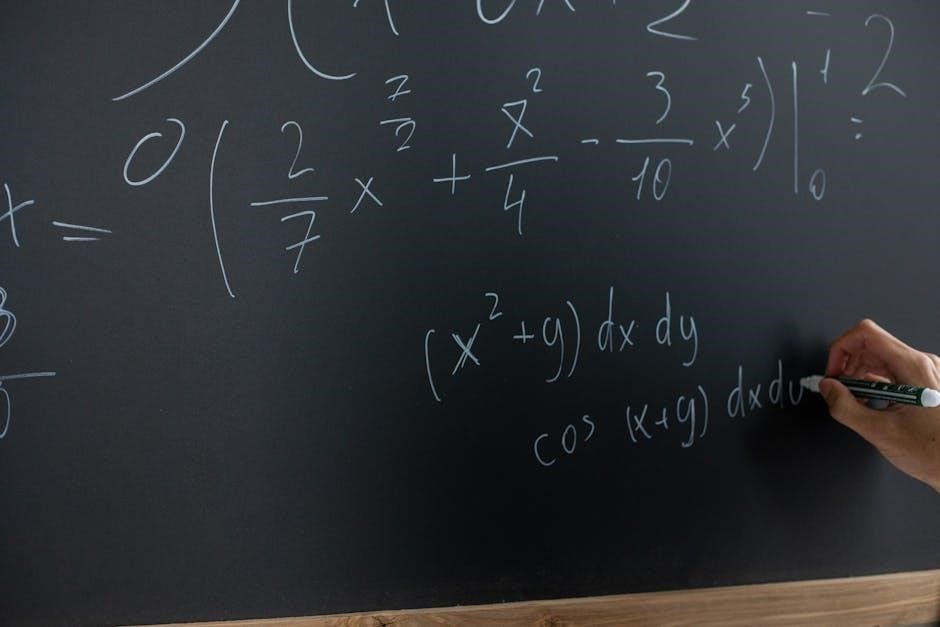
Difficulty arises when transitioning from concrete numbers to abstract variables. Relate algebraic concepts back to numerical examples to build intuition. The PDF format allows for highlighting key definitions and formulas for quick reference. If encountering issues with radicals, review exponent rules thoroughly.
Don’t hesitate to utilize the Ocr functionality (tesseract 5.3.0-6-g76ae) to search for specific examples within the PDF. Remember, persistence is key. Seek help from online forums or tutors when stuck, and revisit challenging concepts regularly. Mastering algebra requires dedicated effort and a willingness to learn from mistakes.